Documentary Limitations: On the Possibility of the Fantastical in the Work of Larissa Sansour
Sascha Crasnow
Drake University
In the opening minute of Larissa Sansour’s two-channel film, In Vitro, an oil-like black substance pours down the narrow historic roads of Bethlehem, sloshing into the Church of the Nativity, and ultimately setting the city aflame. The eerie music that accompanies the black-and-white visuals gives the overall impression of doom and dystopia. While the film was made in 2016, and the cause of the destruction witnessed in the rooftop view of the city is the environmental disaster that has befallen it, in 2025, it is difficult not to view the eruptions of flames in a Palestinian city in the context of the persistent bombing of Gaza. As with all of Sansour’s science fiction films, for which she is most well-known today, her inventions of the future are intimately tied with the present, both in Palestine and across the globe.
When Larissa Sansour began making art, in the early 2000s, she created works that relied on documentary recordings. Video, audio, or both taken within Palestine and documenting the daily lived realities under occupation—restrictions on movement, violence from the army and settlers, and bureaucratic rigamarole—served as the foundation for these works. A Palestinian living in the United Kingdom, Sansour found however, that responses to her videos demonstrated that viewers did not believe the depictions of Palestinian experiences that appeared in her videos. Viewers felt that her position as a Palestinian meant that she was exaggerating Palestinian realities—a common refrain particularly from pro-Israel representatives that call for a “balance” to any Palestinian voice with a pro-Israel one.1 For many international viewers, the absurdist realities of navigating daily life under which Palestinians live seem surreal and thereby impossible to believe. In addition to this, Sansour began to feel limited by the constraints of the documentary form to articulate something beyond the visual narratives told through news stories, which have oversaturated many mass media portrayals of the region to the point of compassion fatigue among non-Palestinian viewership.
In the face of this, Sansour turned to science fiction as a means by which to draw out the dystopian realities of a Palestinian present and the possibilities of Palestinian futures. Science fiction has a long history of imagining futures as a means to talk about the past and present. In the United States for example, media depicting alien invasions and mind control echoed the Cold War anxieties of communist infiltration and xenophobic threats to American white supremacy.2 To bring in just two examples: Invasion of the Body Snatchers, originally a 1955 book, adapted into a film in 1956 (and subsequently in 1978, 1993, and 2007, among other related variations) appealed to the anxieties of individuals on both the left and the right in the Cold War United States: the right saw it as a reference to Communist mind control and the threat of infiltration, while the left read the analogy as one of McCarthyite conformity imposed upon the masses. Science fiction has not just been used to comment on the Cold War of course, but also critically look at other global engagements.3 Another example that has recently returned to the pop culture consciousness with a new series of films based on the original books, Dune, tells the story of a white-savior messiah that examines questions of colonization, exploitation of resources, and the treatment of indigenous populations and lands.
Sansour herself has found that science fiction offers a unique opportunity to engage with concerns of the present without some of the roadblocks she encountered with her documentary works. As she noted in an interview with Visual Culture scholar Anthony Downey, “For me, the allure of sci-fi is to be able to talk about the present without being dictated by the current political jargon. By getting rid of the present-day context, the past and its consequences can be reframed. This is particularly helpful when dealing with the Palestinian question, I think. […] It gives me the chance to single out neglected or overlooked details, enlarge them, and emphasize their importance.”4 In the context of science fiction, debates over exaggeration of realities are pushed aside, and rather, viewers may be enticed to seek out the real-life experiences from which Sansour’s imagined futures stem. Through the contextualization of Palestinian lived experiences into science fiction imaginings, Sansour also creates space for generalizability, forging opportunities for solidarity and connection. In this essay, I discuss two of Sansour’s science fiction works, 2012’s Nation Estate and 2019’s In Vitro examining how the use of science fiction articulates both the specifics of the Palestinian contemporary experience, and through a generalizability, lays the groundwork for potential solidarity in hopes of a better future.
Nation Estate is a 9-minute speculative answer-of-sorts to the “Palestinian question.” With the ever-expanding Israeli settlements and restrictions on new constructions for Palestinians, Sansour imagines a solution to the impossibility of horizontal expansion—verticality. The video follows a woman, played by Sansour, as she makes her way from the Amman Express, presumably a much speedier route from Jordan to Palestine than the existing Allenby Bridge, into the Nation Estate and up to her apartment. While the full scope of the high-rise building is only revealed in full at the end, viewers are given indications as to the structure that the protagonist moves through as she waits for the elevator. An enormous list of floors and their corresponding purposes functions like the directory for a monumental office building, with business names replaced by those of Palestinian cities and bureaucratic infrastructure. Each city’s floor contains a replica of the cultural sites for which it is known. And these are indeed replicas rather than transplanted landmarks, a fact that is evidenced in the final moments of the video as Sansour gazes out of her window, seeing the real Dome of the Rock, replicated on the Jerusalem floor, glimmering in the distance.
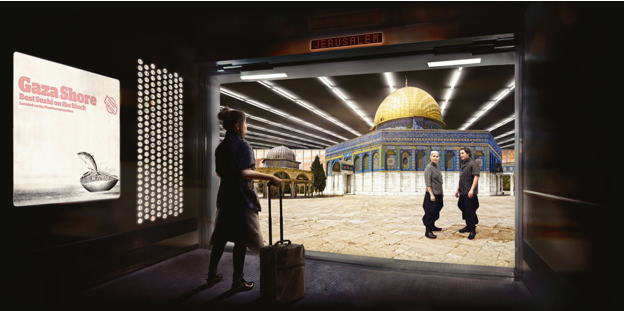
In addition to the icons of the cities themselves, there are many references to distinctly Palestinian symbols throughout the video. The colors of the Palestinian flag—red, green, white, and black—appear not just in the flag hanging in the lobby, but on Sansour’s keycard, food containers, and the biometrics that grant her permission into the building. The cactus and olive tree, both of which, as indigenous plants to Palestine, serve as symbolic references to the land in Palestinian art history and visual culture, make an appearance. The pattern of the keffiyeh, the black and white patterned scarf that was made notable as a nationalist Palestinian symbol through its ubiquitous wear by former Palestine Liberation Organization (PLO) leader and first president of the Palestinian Authority, Yasser Arafat, appears on the crockery in Sansour’s kitchen, in which she places traditional Palestinian meals.
While Sansour herself discusses the use of these symbols as a gesture highlighting the way that they have become ubiquitous yet empty symbols of the nationalist cause, she also, whether intentionally or not, indicates the potential for them to be imbued with new meaning (something she later explicitly aims to do in her 2016 video In The Future They Ate From the Finest Porcelain).5 In the lobby of the Nation Estate hangs a poster advertising the skyscraper. It is modeled on the 1936 “Visit Palestine” poster created by Franz Kraus. While the poster has become associated with Palestinian liberation, resistance, and solidarity, due to its declaration of the existence of Palestine alongside an image of Jerusalem (recognizable because of the Dome of the Rock), thereby also signaling Jerusalem as a part of Palestine, the poster was originally created by Kraus to encourage Jewish immigration to Palestine.6 The use of the word Palestine was simply because that is what the land was called—in 1936, there was no Israel, only the British Mandate in Palestine. The reference to this poster in Sansour’s video adds a distinct aura of possibility to other symbols in the video, and in contemporary Palestinian nationalism, that they too may be imbued with a new, powerful meaning.
Sansour’s Nation Estate is shaped by tension between utopian possibilities and the extension of harsh Palestinian realities to dystopian ends. Sansour herself has said that she does not consider Nation Estate to be either dystopian or utopian.7 While it certainly allows for a greater access between Palestinian cities that would be impossible currently—a Palestinian living in Bethlehem, for example, would only be able to visit Jerusalem with a permit granted by the Israeli government, something infrequently done—the cities that Palestinians are accessing are simulacra of the real thing. Additionally, as the small print in an elevator ad indicates, the mobility that you are granted in the Nation Estate is still subject to potential restrictions—the policing of those who enter the building indicated by the biometric scan Sansour undergoes upon arrival.
While rooted in the experiences of Palestinians, especially restrictions on mobility and access to the breadth of historic Palestine, Nation Estate is couched in the aesthetics of a techno-capitalist future that carries concerns, and thereby potential for solidarity, globally. The stark white that predominates in the building gives it a pristine yet sterile feel that one associates more with an office building than a home.This is emphasized by the lighting that appears on the ceilings of the various floors—tube lighting that accentuates the artificiality of the space and elicits impressions of corporate standardization rather than comfort and home. The aesthetics of the Nation Estate bring to mind the destruction of unique and historic homes, business, and communities to make way for the gentrifying presence of luxury apartment buildings that all look roughly the same—a feature of a growing number of cities globally.
The slick mirrored exterior of the building, and the pillar/phallic-like height of the skyscraper also resemble other monumental buildings, specifically the Burj Khalifa in Dubai, completed in 2009, and One World Trade Center in New York City, the structure of which was completed in 2012, the same year Nation Estate was released.8 Each of these stands as a display of wealth and capitalism. The Burj Khalifa serves as an example of the Gulf Futurist aesthetic that has come to be emblematic of wealth and luxury in the region—centered around hypermodern aesthetics and pushing the limits of what structural engineering can do. In the case of One World Trade Center, the added context of its construction at the site of the former World Trade Center, destroyed during the September 11, 2001 attacks, serves as a symbol of luxury and capitalism as representative of freedom—this is underscored by its position steps away from the Oculus mall, also at the Center’s site. This notion of capitalism-as-freedom sits in stark contrast to Sansour’s Nation Estate, which is surrounded by a now fully enclosing separation wall complete with watchtowers.
The biometric scans that Sansour is subjected to upon entering the building, now in 2025, do not even appear futuristic but rather mirror the experiences of a growing number of airports and border control—perhaps drudging up existing, and exponentially growing since the work was made, concerns surrounding data collection, surveillance, and privacy. The very title of the work belies the two sides to this futuristic vision, especially when considered in the context in which Sansour lives: England. The word “estate” conjures both extreme luxury, like the manors that populate Austen novels, as well as serves to refer to what we call in the States public or project housing, which in the UK are often high-rise structures. The question of what technology and so-called “progress” brings—utopia or dystopia—and for whom, serves as a more generalized provocation Sansour poses to her viewers in Nation Estate.
Sansour’s extension of Palestinian realities to universal concerns through science fiction future imaginings is visible again in her 2019 collaboration with her partner Søren Lind for the Venice Biennale’s Danish Pavillion, In Vitro. The two-channel black-and-white film imagines Bethlehem after an ecological disaster that has sent the surviving population underground. The film centers on two individuals. One is an older woman (played by Hiam Abbas) who lies on her death bed, optimistic about the imminent return of humanity to the surface and their replanting of the heirloom seeds that they have been cultivating in an underground orchard. The other is a younger woman (played by Maisa Abd Elhadi) who it is revealed is a clone of the older woman’s daughter. Her daughter, who we see as a child in flashbacks, presumably perished either during or in the aftermath of the ecological disaster.
Unlike Nation Estate, there are only a few overt references that root this in a distinctly Palestinian context. The exterior shots reveal landmarks that can be recognized as Bethlehem, such as the Church of the Nativity. Dialogue, absent in Nation Estate, is entirely in Arabic. The ecological disaster itself has ties, if not to Palestine specifically, to West Asia as a whole—appearing like a rushing flood of oil.
However, the overarching narrative of a struggle to survive, a desire for thriving agriculture in the face of ecological disaster, and a lack of resources ties in with not Palestinian futures, but contemporary realities. Water resources are already a major concern in Palestine, with the Israeli military taking control of all water resources and infrastructure in the Palestinian Territories after occupying them in 1967.9 A military order prevents Palestinian construction of any new infrastructure related to water without a permit, something almost never granted. According to Amnesty International, even rainwater harvesting cisterns are often destroyed by the Israeli army. This lack of water resources is not just a threat to survival, but also an impediment to farming and agriculture, a longstanding focal industry for Palestinians. Today many farmers are subject to violent attacks on their land, including the destruction of harvesting fields by Israeli settlers in the West Bank and bombing campaigns in Gaza. The underground orchard that is the central focus of above-ground reintegration for the characters in In Vitro echoes the desire for a return to Palestine and commitment to working the land—emphasized by the opening conversation between the two characters, discussing the current state of habitability of the surface.
However, despite these connections to the Palestinian context, Sansour also makes clear the generalizability of the concerns discussed in In Vitro. Dunia, Abbas’ character, notes “Others were beginning to see what we had been experiencing for years.” Sansour herself has noted that many of the environmental effects of climate change and future concerns about resources such as water that are topics of conversations globally, are realities that residents of West Asia are already facing.10 Dunia continues, a word of warning to those globally watching In Vitro, that “it was clear that no place would be spared.” Dunia’s words speak beyond a Palestinian audience to drive home the fact that this ecological dystopia may be taking place in Bethlehem, but the concerns that Sansour is bringing up are ones that extend and should concerns those across the globe.
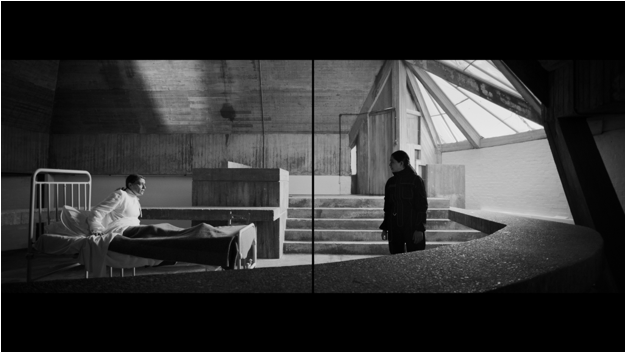
In Vitro also engages with questions of memory and generational trauma. Alia, the clone, speaks about the memories that she has, and her awareness that they are not her own. She states that she was raised on nostalgia. Nostalgia for a place that she did not know—the surface to which she awaits return. However, she does not feel connected to this nostalgia—as a clone, these memories are not her own but are implanted in her. As she remarks, “the loss I feel was never mine.” There are aspects of this that tie in directly to Sansour’s experience as a Palestinian living in diaspora, and of the generation born after 1967 (Sansour was born in 1973). For the generation born prior to the Six Day War (June 1967), what predominates is a nostalgia for a pre-Nakba Palestine.11 For those born after ’67 and the annexation of East Jerusalem, and occupation of the West Bank and Gaza (among other territories), the idea of the Palestine for which the older generations feel nostalgia feels too far away. Rather than looking to the past, many Palestinians of this younger generation are more interested in looking to the future as a means to envision something different for Palestinian liberation than a return to a past from which they feel disconnected. While Sansour envisions this from the perspective of her own experience, feelings of disconnection to ideas of homeland or nostalgia for the past may be relatable to others living in exile or diaspora across ethnic backgrounds.
The conversation continues with Dunia telling Alia that she has only ever known absence. Alia, seemingly bitter about the constant reminder, laments what she describes as her “congenital exile.” While Sansour was born in Palestine, she was born into internal displacement, and later left to study in Europe, ultimately settling there. For many Palestinians, those born within historic Palestine but outside of their ancestral homes as well as those living in diaspora abroad, they are born into a state of exile—perhaps never having set foot in the place from which they have been exiled. Again, while Sansour speaks from her own personal experience and relationship to exile as a Palestinian, for anyone born in diaspora or into a state of exile, these feelings of displacement and a disconnect to home, memories of which may not be your own, may resonate.
While Sansour came to science fiction as a means to move the conversation about Palestine outside of the stifled, controlled, and scrutinized parameters of documentary and reportage, her science fiction works have not allowed her to avoid political pushback entirely. While others may have found science fiction as a means by which to discuss taboo or politically contentious topics in a way that is veiled by their science fiction contexts, Sansour’s position as a Palestinian, and the predominance of what is known as the “Palestinian exception”—the limitations on empathy and free speech when it comes to Palestine—have meant that there has been resistance against her science fiction works as well. In 2011, Sansour was a finalist for a photography prize administered by the Musée de l’Elysée in Lausanne, Switzerland and sponsored by Lacoste. Sansour’s storyboards that she presented as a finalist were related to her Nation Estate project. However, after sharing these with the museum and sponsor, Sansour was removed from the shortlist from the prize due, according to Sansour, because she was told her work was “too pro-Palestinian.”12 The museum and brand both originally stated that Nation Estate did not align with the theme for the year’s award: “joie de vivre.” However, the museum later distanced themselves from Lacoste noting that the interpretation of the theme is always left to the artist, which could include “authenticity or irony.” Ultimately Lacoste withdrew their funding for the award, which was canceled. It was this incident that for many, including myself, first introduced Larissa Sansour and her work.
This is not the only incident of this sort. In 2017, the Barbican was accused of including pro-Palestinian propaganda in an exhibition of science fiction work that included Sansour’s 2016 film In the Future They Ate From the Finest Porcelain. As Gillian Merron, chief executive of the main British Jewish organization in the UK, stated, “This is blatant propaganda, hiding behind the facade of a science fiction exhibition.”13 The Barbican, to their credit, refused to remove the work stating it was art, not propaganda. The exhibition contained a vast array of science fiction works, including Afrofuturist, feminist, and techno-dystopian media of a variety of forms including film, television, and literature. Despite the fact that there were political under (or over) tones in many, if not all the works included in the exhibition, it is only Sansour’s that was singled out as a work with a political agenda. It seems that, even in the realm of science fiction, Palestine becomes an exception.

Sascha Crasnow is an Assistant Professor of Art History at Drake University, specializing in contemporary art from the SWANA region, especially Palestine. She writes on global contemporary art practices, with a particular focus on SWANA (South West Asia and North Africa), race, socio-politics, gender, and sexuality. Her writing has appeared in publications such as Art Journal, the Journal of Visual Culture and Lateral, as well as in a number of edited volumes. Her book project, The Age of Disillusionment: Palestinian Art After the Intifadas, is under review with Duke University Press. She is also co-editor of the forthcoming publication Queer Contemporary Art of Southwest Asia and North Africa with Anne Marie Butler from Intellect Press out in October 2024.
[1] Sansour has made this remark a number of times. Perhaps most recently in Rania Atef, “In Attempts to (Un)forge Present: An Interview with Larissa Sansour and Søren Lind,” NO NIIN 28 (December 2024): https://no-niin.com/issue-28/in-attempts-to-unforge-present-an-interview-with-larissa-sansour-and-soren-lind/index.html
[2] “Cold War” The Encyclopedia of Science Fiction, updated February 19, 2024: https://sf-encyclopedia.com/entry/cold_war
[3] Lisa Reynolds Wolfe, “The Scary Cold War: 1950s Science Fiction Films,” Cold War Studies, September 14, 2023: https://coldwarstudies.com/2023/09/14/the-scary-cold-war-1950s-science-fiction-films/ ; Mark Kiyak, “Are You One of Us, or Are You One of Them?: Five Decades of Invasion of the Body Snatchers,” Georgia Political Science Association: Conference Proceedings 2007, 6.
[4] Anthony Downey, “Epigenetics and Speculative Research: In Conversation With Larissa Sansour,” The MIT Press Reader, April 6, 2020: https://thereader.mitpress.mit.edu/epigenetics-and-speculative-research-larissa-sansour/
[5] Sheyma Buali, “The State of a Nation: Larissa Sansour in conversation with Sheyma Buali,” Ibraaz 007 (May 8, 2014); https://www.ibraaz.org/interviews/125
[6] For a longer discussion of the history of this poster and its changing meaning, see Rochelle Davis and Dan Walsh, “‘Visit Palestine’: A Brief Study of Palestine Posters,” Jerusalem Quarterly 61 (Winter 2015): 47-52.
[7] Buali.
[8] I thank Dr. Sean Kramer for this comparison.
[9] “The Occupation of Water,” Amnesty International, November 29. 2017: https://www.amnesty.org/en/latest/campaigns/2017/11/the-occupation-of-water/ All subsequent data regarding water resources in Palestine are from Amnesty.
[10] Larissa Sansour over Zoom during Q&A film screening event at the Varsity Theater in Des Moines, IA, March 7, 2025.
[11] The Nakba (catastrophe in Arabic) refers to the 1948 Foundation of the State of Israel and exile of ¾ of a million Palestinians.
[12] “Lacoste Prize cancelled amid censorship row,” BBC News, December 22, 2011: https://www.bbc.com/news/entertainment-arts-16299688 All subsequent quotes and information regarding this incident are from the BBC.
[13] David Batty, “Barbican accused of showing antisemitic film in science fiction season,” The Guardian, August 25, 2017: https://www.theguardian.com/film/2017/aug/25/barbican-accused-of-showing-antisemitic-film-in-science-fiction-season All subsequent information regarding this incident is from the Guardian.